The Ford logo is the Blue Oval with the flowing “Ford” script inside it. The script dates from the company’s earliest years, while the oval shape was adopted in the early 1900s and became a regular feature on Ford cars from the late 1920s. The design has been refined several times since, but its core has barely changed for about a century, which makes it one of the most recognisable car badges in the world.
Timeline at a glance
| Period | Logo development |
|---|---|
| 1903 | Ford Motor Company founded; first emblem is an ornate, decorative badge with the company name |
| Early 1900s | The cursive “Ford” script appears, a style generally credited to an early Ford engineer |
| 1907 | An oval mark is used by Ford’s agents in Britain to signal quality and reliability |
| 1912 | A winged “The Universal Car” logo is used for a period |
| 1927 | The Blue Oval with script appears on the Model A, becoming the long-term identity |
| Later decades | Repeated refinements to colour, depth and lettering |
| 2003 | A refreshed “Centennial” Blue Oval marks the company’s 100th anniversary |
Exact dates and details vary slightly between sources, but this outline matches the history Ford itself presents.
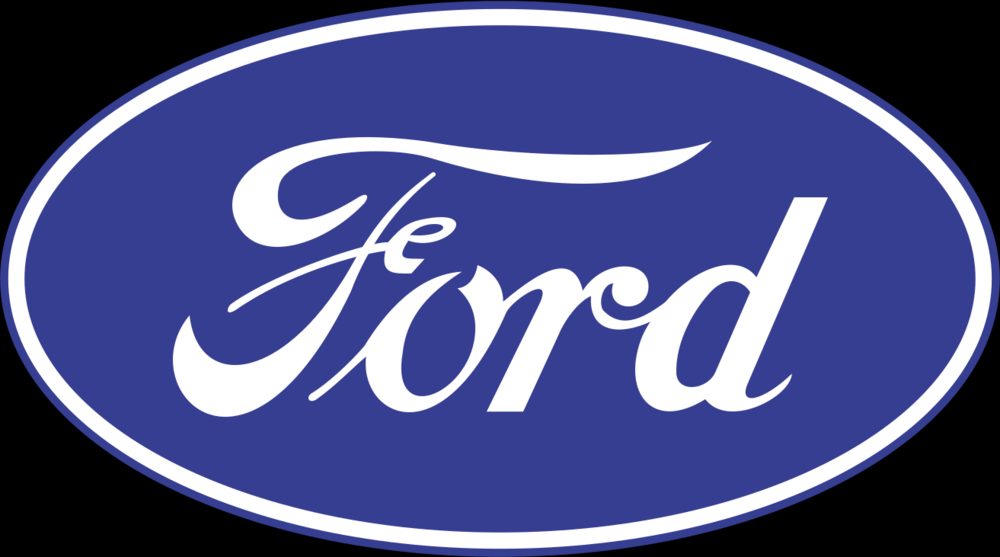
The script: older than the oval
The handwritten-style “Ford” lettering was created very early in the company’s history. It is often said to resemble the style of business cards and signatures popular at the time. The script gave the brand a personal, friendly feel that suited a company selling cars to ordinary families, not just the wealthy.
Over the years, the script has been tidied and redrawn for clarity, but the characteristic swooping “F” and the looped “d” have stayed. That continuity is a big part of why the badge feels familiar across generations.
The oval: from reliability mark to brand
The oval shape was first used as a mark of reliability by Ford’s dealers and agents, and later moved onto the cars themselves. When the Model A arrived in 1927, it carried a blue oval badge, and from then on the oval became the company’s main identifying mark. Ford often uses the term “Blue Oval” to describe both the logo and the company itself.
Why the logo works
- Simple shape that reads clearly at any size, from a key fob to a dealership sign
- Script that feels human and approachable
- Strong colour that stands out on grilles and tailgates
- Very few changes over decades, which builds recognition
The logo on Ford vehicles today
Most modern Fords wear the Blue Oval on the grille and the tailgate or boot lid. Some models, however, carry their own identities instead:
- Mustang cars typically use the running pony emblem, not the Blue Oval, on the grille. Read more in our guide to the Mustang logo.
- Bronco uses its own horse badge.
- Performance models such as Raptor and Shelby carry additional badges and lettering.
- F-150 and Super Duty trucks often feature large Blue Ovals or “FORD” lettering across the grille, depending on trim.
Genuine badges and replicas in the UAE
Badges are among the most commonly swapped parts on cars here, whether to update an older car, change a trim look, or replace a faded emblem baked by the sun.
When buying a used Ford
- A new-looking badge on an old car is not a problem, but check that model and trim badges match the VIN and specification
- Performance badges such as Raptor, GT or Shelby do not prove the car is that model
- Grille badges can hide radar sensors on newer cars; aftermarket replacements may affect driver-assistance systems
- Ask a dealer to confirm the specification from the VIN if in doubt
On newer Fords with adaptive cruise control and other driver aids, the front badge area can be part of the sensor system. Fitting the wrong badge or a thick wrap can interfere with radar performance. Use genuine parts from an authorised dealer for those cars.
Caring for badges in the UAE climate
Sun, sand and frequent car washes can fade or pit emblems over time. Simple habits help:
- Use a soft brush or microfibre cloth around badges rather than abrasive pads
- Avoid harsh chemicals or high-pressure jets aimed directly at the edges of emblems
- Park in shade when possible
- If a badge peels, replace it with a genuine part rather than gluing a loose one back on
A century of small refinements kept the Ford logo instantly recognisable.
How the logo changed with technology
Each refresh of the Blue Oval reflected the tools of its time. Early badges were enamel and metal, made by hand and fitted to radiators. As mass production grew, stamped and chromed emblems took over, and later plastic badges with chrome finishes became standard because they were lighter and cheaper to produce.
Printing and screens also shaped the logo. Colours that looked right in a brochure did not always look right on a television screen or a website, so Ford adjusted shades and contrast over the decades. In recent years, the company has also used simplified, flat versions of the oval for apps, digital displays and social media, while keeping the more detailed, three-dimensional look for physical badges on vehicles.
Lighting is another recent change. Some markets and models now feature illuminated emblems, and electric Fords use the logo alongside new lighting signatures. Rules on illuminated badges differ between countries, so check local regulations before fitting aftermarket lit emblems to a car registered in the UAE.
Fun facts for Ford fans
- The Blue Oval’s colour has been adjusted several times to suit printing, paint and lighting technology of each era.
- Ford’s centenary in 2003 brought a refreshed oval with subtle shading and a crisper script.
- Dealers, merchandise and racing liveries all use variants of the same core design, which is why it looks consistent everywhere.
If you are choosing your next Ford rather than just admiring the badge, our Ford model comparison shows the current line-up.
Frequently asked questions
When did Ford start using the Blue Oval on cars?
The Blue Oval with the Ford script appeared on the 1927 Model A and became the long-term identity.
Who designed the Ford script?
The script is generally credited to one of Ford’s early engineers in the company’s first years.
Why does the Mustang not have a Ford logo on the front?
Mustang has its own running pony emblem, which has been the model’s identity since the 1960s.
Can I replace my grille badge with an aftermarket one?
On newer cars, check first. The front badge area may house radar sensors used by driver-assistance systems.
Sources: Ford Motor Company corporate history, The Henry Ford museum, Ford
Last reviewed: 2026-11-25.



0 Comments