The Ford GT is Ford’s road-going supercar, built in two modern generations: the first from 2005 to 2006 and the second from 2017 to 2022. Both were inspired by the GT40 race cars that won Le Mans in the 1960s, and both are rare, highly collectable cars that occasionally appear in the UAE through specialist dealers and private collections.
From GT40 to Ford GT
The GT40 was Ford’s 1960s endurance racer, created to beat Ferrari at the 24 Hours of Le Mans. It won the race four years in a row from 1966. Decades later, Ford revisited that story twice with road cars carrying the GT name. If you want the full story of the original racer, read our guide to the Ford GT40.
| Production | 2005 to 2006 model years | 2017 to 2022 |
|---|---|---|
| Concept | Modern homage to the GT40 shape | Road car developed alongside a Le Mans race car |
| Engine | Supercharged V8 | Twin-turbocharged EcoBoost V6 |
| Construction | Aluminium spaceframe | Carbon-fibre tub with aluminium subframes |
| How to buy | Ordered through dealers | Application process; buyers selected by Ford |
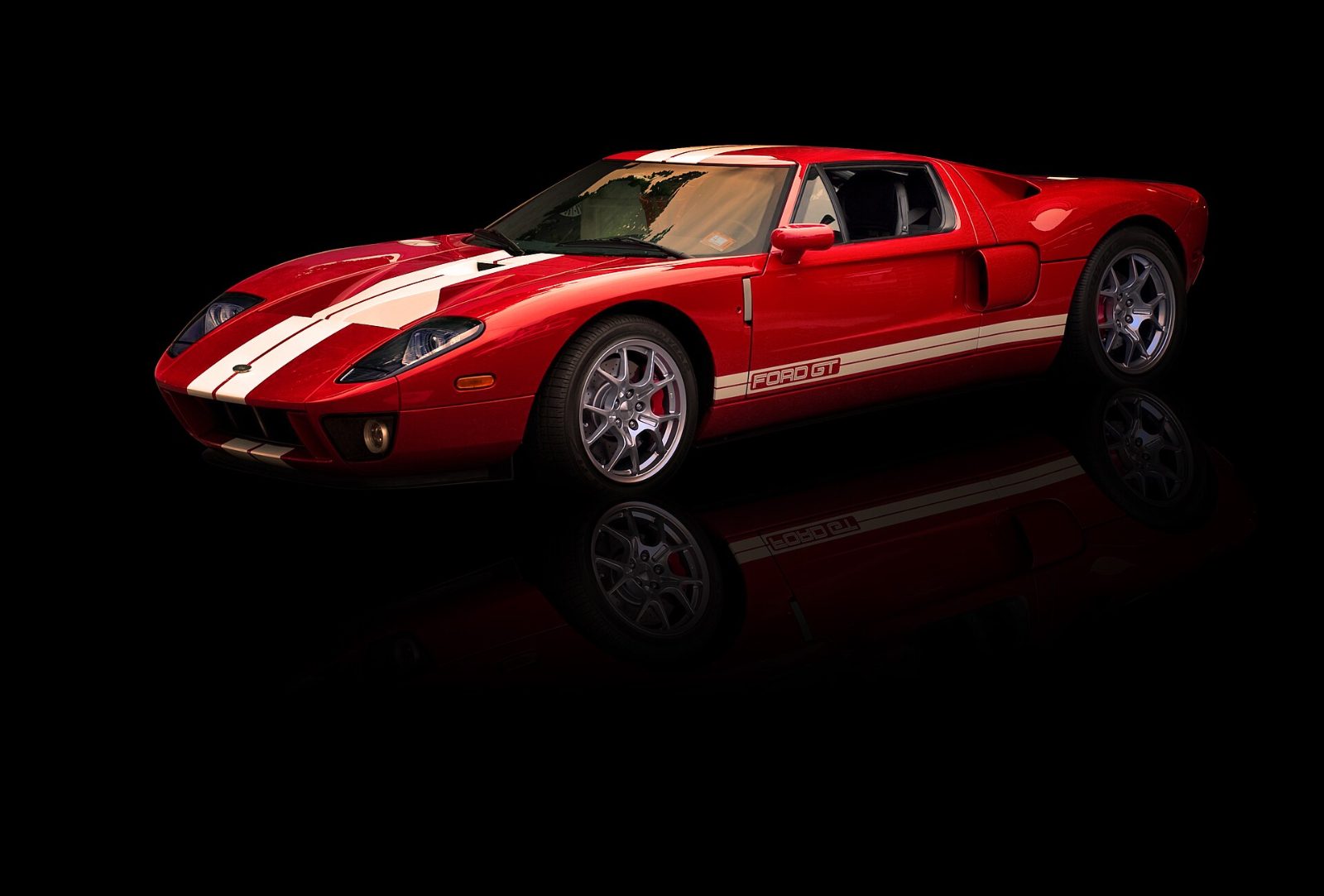
First generation (2005 to 2006)
The first Ford GT was revealed as a concept for Ford’s centenary in 2003, and production followed. It closely echoed the GT40’s look, but it was larger, with modern safety and comfort features. A mid-mounted supercharged V8 and a manual gearbox gave it serious performance for its time, and it became an instant classic.
Values have risen strongly over the years. Well-kept, low-mileage cars with documentation are the most sought after, and limited-edition variants and special colours carry premiums.
Second generation (2017 to 2022)
The second Ford GT was developed with racing in mind from the start. A race version entered Le Mans and won its class in 2016, fifty years after the GT40’s first victory. The road car used a carbon-fibre structure, active aerodynamics, adjustable ride height and a twin-turbocharged 3.5-litre EcoBoost V6. Its teardrop shape with flying buttresses was shaped largely by airflow.
Ford limited production and asked prospective buyers to apply, considering factors such as their history with Ford and how they planned to use the car. Buyers also agreed to conditions intended to discourage quick resale. Several special editions marked the car’s racing heritage.
Second-gen highlights
- Carbon-fibre passenger cell
- Active rear wing and adjustable suspension modes
- EcoBoost V6, the same engine family used in other Fords, in very high tune
- Class victory at Le Mans in 2016 for the race version
Ford GT in the UAE
The UAE has a strong collector and supercar scene, and both generations of Ford GT have been seen at events and in private collections. If you are considering buying one, the process is closer to buying a collectable artwork than a normal car.
Verify everything
- Confirm the VIN with Ford and check that it matches the documents
- Review the full ownership history and any import documents
- Check whether the car is GCC spec or imported, and how it was shipped
- For second-generation cars, ask about any resale agreements that applied to earlier owners
Inspection
Use a specialist familiar with carbon-fibre structures and high-performance cars. Accident repairs on carbon structures need expert assessment. Check tyres, which age even with little use, and fluid service records.
Heat and storage
Supercars that sit for long periods in hot climates suffer from ageing tyres, battery drain and dried seals. Store in a cool, covered space, use a battery maintainer, and exercise the car regularly according to the manufacturer’s guidance.
Insurance and registration
Agreed-value insurance through a specialist provider is usually more appropriate than standard cover. Registration follows the normal process with your emirate’s traffic authority, including inspection, but check any import paperwork carefully before purchase.
With a Ford GT, provenance and paperwork matter as much as the car itself.
Living with a Ford GT
Daily usability
Neither generation is a practical daily car. The first-generation GT has a small cabin, limited luggage space and a firm ride, but it is relatively straightforward mechanically and many owners drive their cars on weekends. The second-generation GT is even more focused. Its cabin is narrow, storage is minimal and the suspension is built for speed rather than comfort, although a raised ride-height mode helps with speed bumps and ramps.
In the UAE, the practical issues are ground clearance in car parks and villa driveways, and heat soak in summer traffic. Owners often plan routes to avoid steep ramps and drive in the cooler hours.
Running costs
Servicing a limited-production supercar is expensive and best done by technicians trained on the model. Tyres are specialised and must be replaced by age as well as wear. Carbon-fibre body repairs are costly and can take a long time if parts must be shipped. Insurance with an agreed value is usually the largest annual cost after depreciation or appreciation.
Using it as intended
Track days at Dubai Autodrome or Yas Marina are an option for some owners, though many collectors avoid adding miles. If you do take a GT on track, follow the same preparation as any performance car: fresh brake fluid, careful tyre pressures and cool-down laps. Treat the car’s market value as part of the risk you are taking.
Ford GT versus other Ford performance cars
The GT sits far above anything else in Ford’s range in price and rarity. For most enthusiasts, the Mustang GT, Mach 1 and Shelby models offer much of the excitement for a fraction of the cost, and they can be driven daily. See how the current range compares in our Ford model comparison.
Frequently asked questions
How many generations of Ford GT are there?
Two road-going generations: 2005 to 2006 and 2017 to 2022, both inspired by the 1960s GT40.
Did the Ford GT win Le Mans?
The race version of the second-generation GT won its class at Le Mans in 2016.
Why did Ford use a V6 in the second-generation GT?
The twin-turbo EcoBoost V6 suited the car’s compact, aerodynamic packaging and its racing programme.
Can I buy a Ford GT new?
Production of the second generation has ended. Cars are now sold through specialist dealers, auctions and private sales.
Sources: Ford Performance, 24 Hours of Le Mans, RTA Dubai
Cover photo: Dietmar Rabich, CC BY-SA 4.0. Last reviewed: 2026-11-25.

0 Comments